Moroccan Fossil Decor: What It Is, How It’s Made & Why It’s Unique
limitlessmoroccotours.com
20 September 2026
Morocco is famous for its colorful markets, handmade carpets, pottery, leather, and traditional crafts. But there is another Moroccan craft that many travelers discover for the first time when visiting the country: Moroccan fossil decor.
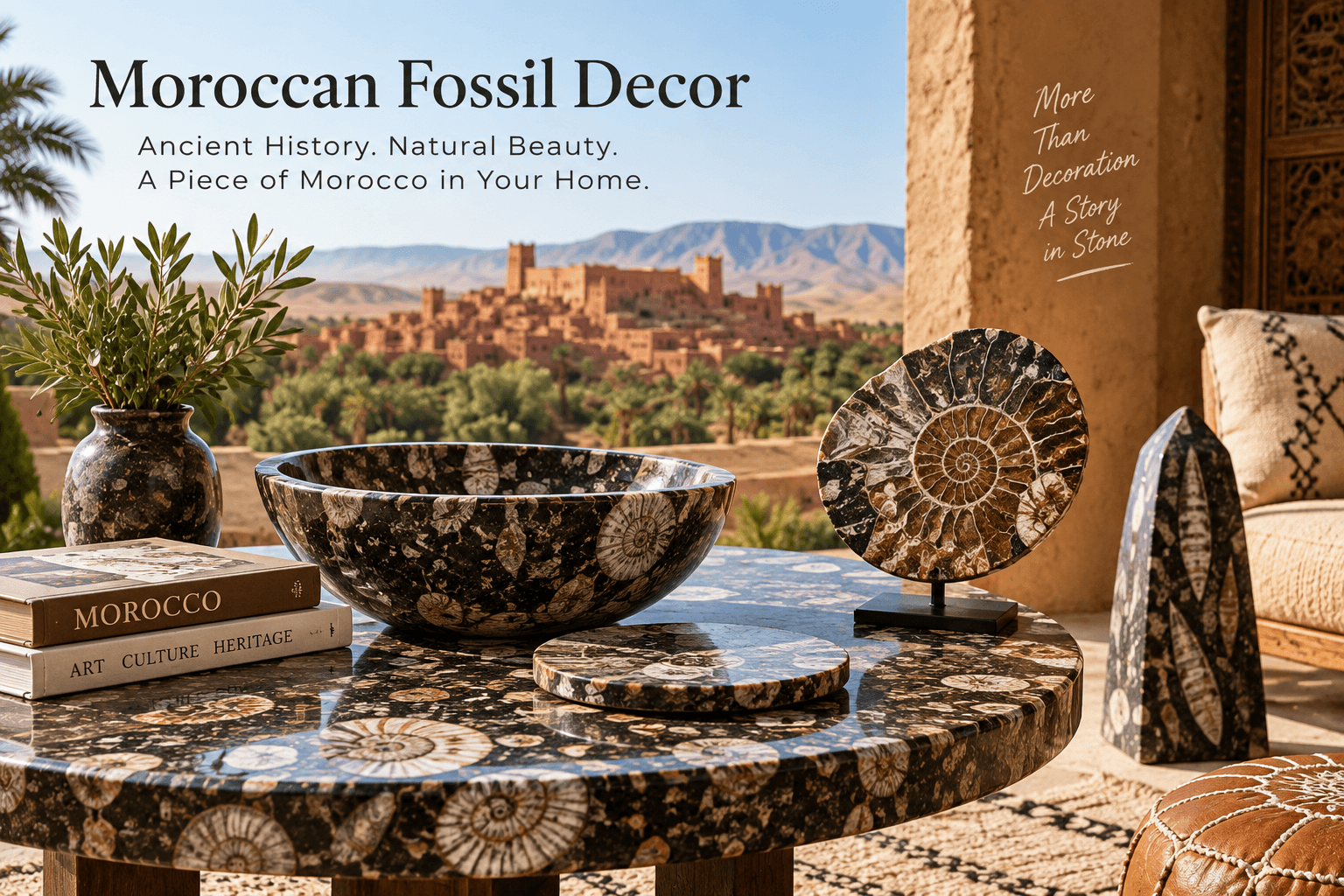
Across Morocco, ancient fossils are found inside stone that can later be cut, polished, and shaped into beautiful decorative pieces. You may see fossil tables, sinks, plates, bowls, countertops, small ornaments, and other objects.
What makes this decor special is simple: the patterns inside the stone were not designed by a machine. They were created by nature millions of years ago.
A Moroccan fossil piece can therefore be both a decoration and a small piece of natural history.
In this guide, we explain what Moroccan fossil decor is, where the fossils come from, how the stone is prepared, what types of decor you can find, and how travelers can buy fossil decor while visiting Morocco.
What Is Moroccan Fossil Decor?
Moroccan fossil decor is made from natural stone containing visible fossils.
After the stone is cut and polished, the fossils inside it become much easier to see. Craftsmen can then turn the stone into furniture, household items, or decorative objects.
Depending on the piece, you may see different fossil shapes and patterns across the surface.
No two pieces are exactly the same.
That is one of the main reasons people like Moroccan fossil stone. Even when two tables have the same shape and size, the fossil patterns inside them will be different.
Common fossil decor can include:
- Fossil tables
- Coffee tables
- Side tables
- Sinks
- Basins
- Plates
- Bowls
- Decorative boxes
- Countertops
- Small display pieces
- Sculptures and ornaments
Some pieces are simple and natural, while others are carefully shaped and highly polished.


Why Are There So Many Fossils in Morocco?
Morocco is well known among fossil collectors because many parts of the country contain ancient sedimentary rocks.
Long before modern Morocco existed, different areas were covered by ancient seas and other environments where marine animals lived.
Over very long periods of time, some of these organisms became preserved inside layers of sediment. Those layers eventually became rock.
This is why Morocco fossils can include the remains of ancient marine life.
Today, fossil-bearing stone is especially associated with areas in southeastern Morocco, where fossil cutting and polishing have also become an important local craft.
For visitors, this creates an interesting connection between geology and traditional craftsmanship.
The fossil itself may be ancient, but the finished table, bowl, or decorative object is created by a modern Moroccan artisan.
What Types of Fossils Are Found in Moroccan Decor?
Different types of fossils can appear in decorative stone from Morocco.
Some of the best-known examples include ammonites, orthoceras-type fossils, and trilobites.
Ammonites
Ammonites were marine animals with spiral-shaped shells.
Their circular or spiral forms can look especially attractive when stone is cut and polished.
Because of their shape, ammonite fossils are often used in decorative objects, tabletops, and display pieces.
Orthoceras-Type Fossils
You may also see long, straight fossil shapes in dark stone.
These are commonly sold in the fossil trade as Orthoceras fossils.
When several appear together in polished stone, they create a natural pattern that works well for tables, sinks, and other decorative items.
Trilobites
Trilobites are another fossil strongly associated with Morocco.
They lived hundreds of millions of years ago and are popular with fossil collectors around the world.
Trilobites are often sold as individual specimens rather than simply used as decorative stone.
We will cover Moroccan trilobite fossils separately in another guide because they deserve a more detailed explanation.
How Is Moroccan Fossil Decor Made?
Turning fossil-bearing rock into finished decor takes several steps.
The exact process depends on the type and size of the item, but the basic idea is straightforward.
Fossil Stone Is Selected
The process starts with stone containing visible fossils.
Craftsmen choose material based on its fossil patterns, quality, size, and suitability for the item they want to create.
A large tabletop obviously requires a different piece of stone than a small bowl or decoration.
The Stone Is Cut
The stone is then cut into the required shape.
This is an important stage because cutting the stone can reveal fossils that were not clearly visible from the outside.
For a table, workers may create a large flat surface.
For a bowl, basin, or sink, the stone needs more shaping.
The Surface Is Shaped
The material is refined until it reaches the desired form.
Edges may be rounded, surfaces flattened, and decorative details added depending on the design.
The Stone Is Polished
Polishing is one of the most important parts of the process.
Before polishing, the fossils may look dull or difficult to see.
After polishing, the contrast between the fossil and surrounding stone becomes much clearer.
This is often what gives Moroccan fossil stone its distinctive appearance.
The Piece Is Finished
The final step depends on the product.
A tabletop may need a base. A sink needs its interior and drainage area finished correctly. Smaller decorative items may simply need final polishing.
The finished object combines natural fossil material with Moroccan craftsmanship.
Why Is Moroccan Fossil Decor Unique?
The biggest reason is that every piece is naturally different.
With factory-made decoration, hundreds or thousands of products can have exactly the same pattern.
That cannot happen in the same way with fossil stone.
The location, size, shape, and number of fossils vary from one piece of rock to another.
A fossil table may contain several clearly visible fossils, while another may have smaller and more detailed patterns.
This means buyers are not simply choosing a design.
They are choosing a particular piece of natural stone.
That gives Moroccan fossils a very different character from ordinary home decoration.
Is Moroccan Fossil Stone the Same as Marble?
You may sometimes see products described as “Moroccan fossil marble.”
This is a common commercial name used for polished fossil stone.
However, not every stone sold under that name is true marble in the geological sense.
Many fossil-bearing decorative stones are limestone or other sedimentary rocks containing fossils.
For shoppers, the most important thing is to look at the actual stone, fossil patterns, finish, quality, and craftsmanship rather than relying only on the word “marble.”
If you are buying a more expensive piece, it is reasonable to ask the seller exactly what type of stone was used.
Are Fossils From Morocco Real?
Many fossils from Morocco are genuine, and Morocco has a major fossil trade.
However, buyers should still understand that fossil products can vary.
A decorative object can contain real fossils while also being cut, polished, repaired, assembled, or shaped by people.
That does not automatically make the fossil fake.
For example, a fossil table is obviously a manufactured piece of furniture, but the fossil-bearing stone used to make it can still be natural.
Individual collector fossils require more careful inspection because restoration or reconstruction may sometimes be present.
If your main interest is home decor, focus on the quality of the stone, visible fossils, polishing, construction, and overall finish.
Popular Types of Moroccan Fossil Decor
There are many ways fossil stone can be used.
Moroccan Fossil Tables
Fossil tables are among the most impressive pieces.
The large polished surface makes it easy to see different fossils and natural patterns.
They can be used as dining tables, coffee tables, side tables, or decorative furniture.
Fossil Sinks and Basins
Stone containing fossils can also be shaped into sinks and basins.
These pieces combine a practical function with a natural decorative surface.
Fossil Plates and Bowls
Smaller fossil plates and bowls are easier to display and transport than furniture.
Some are designed mainly as decoration rather than for serving food, so buyers should ask about the intended use of a particular item.
Fossil Decorative Objects
Small boxes, sculptures, ornaments, and other pieces are also available.
These can be a practical option for travelers who like fossil decor but do not want to buy a large item.
How to Display Moroccan Fossils at Home
You do not need a large fossil table to use fossil decor in your home.
A small piece can work well on a shelf, desk, coffee table, or display cabinet.
For a simple look, avoid placing too many decorative objects around it.
The fossil patterns themselves provide most of the visual interest.
A larger fossil table can work as the main feature in a room, while smaller pieces can be used as accents.
Good lighting also helps.
When light reaches a polished fossil surface, many of the details become easier to see.
How to Care for Moroccan Fossil Decor
Fossil stone is relatively easy to care for, but it should still be treated properly.
Use a soft cloth for regular cleaning.
For many pieces, mild soap and water are enough.
Avoid using strong chemicals unless you know they are suitable for the exact stone and finish.
For tables and other large pieces, it is also a good idea to:
- Clean spills without leaving them for a long time.
- Avoid very abrasive cleaning products.
- Use coasters or mats when appropriate.
- Lift heavy pieces carefully instead of dragging them.
- Ask the seller whether the surface has been sealed.
Care instructions can vary depending on the stone and finish, so always follow any specific advice provided with the item.
Can You Buy Moroccan Fossil Decor in Morocco?
Yes. Travelers can find fossil products in different parts of Morocco, especially in areas connected with fossil cutting, handicrafts, and tourism.
The available pieces can range from small decorations to large furniture.
If you are interested in buying fossil decor during your Morocco trip, Limitless Morocco Tours can also help you find available pieces locally.
Our family has access to Moroccan fossil decor in Morocco, including pieces owned by the family. This means travelers who are interested can contact us to ask what is currently available and discuss purchasing options.
This can be particularly useful if you want to see the piece before buying it instead of ordering something without knowing exactly what you will receive.
For large items, buyers should also consider transport, packaging, weight, and shipping before making a final decision.
What Should You Check Before Buying?
Before buying Moroccan fossil decor, look closely at the complete piece rather than only the fossils.
Check:
- The quality of the polishing
- Cracks or visible repairs
- The stability of tables or furniture
- The quality of the edges
- The fossil patterns
- The size and weight
- Whether the piece is practical to transport
- What is included in the price
- Shipping arrangements for large pieces
For expensive items, ask questions before buying.
A good seller should be able to explain the material, dimensions, condition, and basic details of the piece.
Moroccan Fossil Decor as a Souvenir
Most visitors think of carpets, leather bags, ceramics, spices, or argan oil when they think about souvenirs from Morocco.
Fossil decor offers something different.
A small fossil piece can be a reminder not only of Moroccan craftsmanship but also of the country’s ancient geological history.
Large furniture is obviously more complicated to transport, but smaller fossil decorations can be easier for travelers to take home.
For people interested in geology, natural history, interior design, or unusual handmade objects, it can be one of the more distinctive things to discover in Morocco.
Frequently Asked Questions
A Moroccan fossil is the preserved remains or trace of ancient life found in rock from Morocco. Different types of fossils are found in the country, including marine fossils that can be millions of years old.
Many areas of Morocco contain ancient sedimentary rocks formed in environments where organisms could become buried and preserved. Over long periods of geological time, some of these remains became fossils.
Moroccan fossil stone is natural stone containing visible fossils. It can be cut and polished to create tables, sinks, bowls, plates, decorative objects, and other products.
Many Moroccan fossils are genuine. However, fossil products can also be cut, polished, repaired, or assembled. Buyers interested in collectible fossils should ask about restoration and preparation.
Common items include tables, sinks, basins, bowls, plates, countertops, boxes, and decorative pieces.
Yes. Fossil decor is available in Morocco in different sizes and styles. Travelers should consider quality, price, weight, transport, and shipping before buying large pieces.
Yes. Limitless Morocco Tours can help interested travelers ask about fossil decor available locally through our family in Morocco. Contact us before or during your trip to ask about current pieces and purchasing options.
Final Thoughts
Moroccan fossil decor is more than ordinary decoration.
It combines ancient natural material with modern Moroccan craftsmanship. A polished table, bowl, sink, or decorative object can reveal fossils that formed long before humans existed.
That is what makes each piece different.
Whether you are interested in geology, interior design, Moroccan crafts, or simply want something unusual for your home, fossil decor offers a side of Morocco that many travelers never expect to discover.
If you are visiting Morocco and would like to see Moroccan fossil decor or ask about pieces available through our family, you can contact Limitless Morocco Tours for more information.
- 4-day Casablanca to Marrakech desert tour
- 5-day Morocco tour from Casablanca
- 7-day Sahara desert tour from Casablanca
- 8-day imperial cities tour from Casablanca
- 10-day Morocco tour from Casablanca
- 10-day Imperial cities Tours from Casablanca
- 12-day grand Morocco adventure tour
- 14-day Morocco tour from Casablanca
- 3 Days Tour Marrakech To Merzouga Desert
- 3 Day Marrakech to Fes Desert Tour via Merzouga & Erg Chebbi
- 4 Day Sahara Desert Tour from Marrakech
- 4 Day Marrakech to Fes Desert Tour with Camel Trek & Sahara Experience
- 5-day Marrakech to Fes desert tour
- 6 day Morocco desert tour from Marrakech
- 7-day imperial cities tour Marrakech