14 Day Morocco Tour from Marrakech: Desert, Cities and Coast
14 Day Morocco Tour from Marrakech: Desert, Cities and Coast
- Marrakech
Duration
14 Days / 13 Nights
Tour Type
Private tour
Group Size
7 Peoples
Languages
English, French,, Spanish
- Overview
A 14 day Morocco tour from Marrakech gives you time to do what shorter trips can’t: cross the High Atlas, spend two nights in the Sahara, walk the old medina of Fes, see the blue streets of Chefchaouen and finish on the Atlantic coast, without squeezing it all into a few days.
The route is a loop that starts and ends in Marrakech. You head south over the Tizi n’Tichka pass to Ait Ben Haddou and Ouarzazate, follow the Dades and Todra valleys to Merzouga, then turn north through the Ziz Valley and the Middle Atlas to Fes. From there the road continues to Chefchaouen and Rabat, then down to Essaouira on the coast, before ending back in Marrakech. The last three days run Rabat, Essaouira, Marrakech so the tour never doubles back on itself.
Variety is the point. In two weeks you go from red city walls to mud-brick kasbahs and palm groves, from the dunes of Merzouga to cedar forests, from the narrow lanes of Fes to the wind and gulls of Essaouira. Marrakech and Fes each get a full day on the ground, and the second night in the Sahara gives you a full day in the desert with no driving.
It is also a road trip, and it is fair to say so. Five days have roughly four to six and a half hours of driving: Days 3, 5, 7, 10 and 12. Day 12, from Rabat to Essaouira, is the longest. The other days are shorter, and Days 1, 2, 6, 9 and 14 have no long drives at all.
Tour at a glance
- Starts and ends in Marrakech
- 14 days and 13 nights
- Moroccan hotels or riads, plus two nights in the Merzouga desert area
- Main stops: Marrakech, Ait Ben Haddou, Ouarzazate, Dades Valley, Merzouga, Midelt, Fes, Chefchaouen, Rabat and Essaouira
Who this tour suits
A Morocco 2 week itinerary like this one suits travelers who want to see several regions in one trip and are happy to spend time on the road. It works for couples, friends and families whose children handle long drives well. It is a weaker fit if you prefer to stay in one place or want to avoid early starts.
Make it your own
Limitless Morocco Tours plans personalized trips, and this Morocco tour package is a starting point rather than a fixed script. If you would like a different pace, an extra night somewhere or a change to the order of stops, tell us and we will say what works on the road. To check dates and ask for a quote on the 14 day Morocco tour, send us your travel dates, the number of travelers and any changes you have in mind.
- 14 Day Morocco Itinerary, Day by Day
14 Days / 13 Night
This 14 day Morocco itinerary moves around the country in one direction: south and into the desert first, then up through the Middle Atlas to Fes and the north, and finally down to the Atlantic coast. Driving times are approximate and change with traffic, weather and stops.
Nothing is planned for the first day except getting here. Arrive whenever your flight or train comes in, and a transfer takes you to your hotel or riad in Marrakech. If your riad is inside the old medina, the last few minutes may be on foot, because many lanes are too narrow for cars.
After that the afternoon is yours. A short walk nearby is enough. Find a café, notice the sounds, and let the city settle in your head before tomorrow. Marrakech is warm, busy and a little overwhelming at first, so an early night helps.
Overnight: Marrakech.
Today runs from quiet to loud, on purpose. Start at the Koutoubia Mosque, the 12th century minaret you can see from much of the city. Non-Muslims can’t go inside, so this is an exterior visit, and the gardens around it are a calm place to begin.
Next comes the Bahia Palace, built in the late 1800s. Painted cedar ceilings, tiled courtyards and orange trees make a sharp contrast with the streets outside. It normally requires an entrance ticket.
From there you move into the souks, north of the main square. Each trade has its own lane: leather, metalwork, spices, lanterns. It is narrow, noisy and easy to get lost in. Bargaining is part of the game, and saying no politely is fine.
End the day at Jemaa el-Fnaa, the big square. It looks half empty in the afternoon. At dusk, food stalls and performers fill it.
Overnight: Marrakech.
Leave early. This is the day the scenery changes completely. The road climbs from the Marrakech plain into the High Atlas and crosses the Tizi n’Tichka pass at about 2,260 meters, one of the highest road passes in the country. The bends are tight, and Amazigh (Berber) villages cling to the slopes below. In winter, snow or ice can slow the pass.
On the far side, the land dries out and turns red and brown. About four hours in, you reach Ait Ben Haddou, a fortified village of earthen buildings stacked up a hillside above a river. It is a UNESCO World Heritage site, and only a few families still live inside. Crossing the river and climbing through the alleys to the top takes an hour or more, and the view over the valley and the palms is worth the effort. Film and TV crews have used the village many times, so parts of it may look familiar.
From Ait Ben Haddou, Ouarzazate is a short drive further on. It is a wide, quiet town on the edge of the desert, and a calm place to end a long day. In total, expect about 200 km and 4.5 to 5 hours of driving, plus time at the ksar.
Overnight: Ouarzazate.
After yesterday, today is easy. The drive is short, about 140 km and 2.5 to 3 hours, so there is room to stop. First comes Skoura, a palm grove where old mud-brick kasbahs stand among the trees. The road runs right through it.
Further east, the road follows the Valley of Roses. The roses flower around April and May, and the area is known for its rose harvest. Outside that season the valley is still a green strip in dry country, and shops sell rose water and soap.
You reach Boumalne Dades in the early afternoon, which leaves time for the Dades Gorge. A short drive up the valley, the road climbs in sharp hairpins through red cliffs and odd, eroded rock shapes known as “monkey fingers”. The light on the cliffs is best in late afternoon.
Overnight: Boumalne Dades.
The day starts with Todra Gorge, about an hour from Boumalne Dades near the town of Tinghir. A river has cut a narrow canyon here, and at its tightest point the rock walls rise hundreds of meters with little room beyond the road and the stream. Walk in a little way. It is cooler in the shade, and the palm gardens at the Tinghir end are green against the stone.
After that, the road heads southeast and the landscape strips down: flat stony plains, scattered oasis towns, long straight roads. This is a long driving day, around five to six hours in total, so keep the gorge to a short stop.
You reach Merzouga in the late afternoon. The village sits at the edge of Erg Chebbi, a huge field of dunes that rise to about 150 meters. Tonight you sleep at a desert camp. As the light drops, the dunes shift from orange to deep red, and on clear nights the stars are very bright, since there is almost no light pollution. Ask us about camp details when you request a quote.
Overnight: Sahara Desert camp (first night).
No driving today. After a long road day, this one is for slowing down, and it is the reason the desert gets two nights instead of one.
Erg Chebbi looks different at every hour. Early on, the sand is cool and the shadows are long. By midday it is bright and hot, especially in summer, when mornings and evenings are the comfortable hours. In winter the days are mild and the nights are properly cold. Apart from the wind, it is very quiet.
How you spend the day depends on the camp and the season. Limitless Morocco Tours can tell you what is available when you request a quote.
Overnight: Sahara Desert camp (second night).
You leave the dunes and head north, and the scenery changes every hour. It is a long day, about 300 km and 5.5 to 6 hours of driving.
First the road crosses flat desert toward Erfoud and Errachidia. Then comes the Ziz Valley, a long ribbon of palm oasis that follows the Ziz River, bright green against pale rock. In places the valley narrows into gorges before the road starts to climb.
Midelt sits at about 1,500 meters, between the High Atlas and the Middle Atlas. The air is noticeably cooler, and apple orchards replace the palms. It is a small town and not a sightseeing stop. Its job is to break the long trip between the desert and Fes. Pack a warm layer for the evening, even in spring.
Overnight: Midelt.
Today feels like another country. The road crosses the Middle Atlas, a region of cedar forest, green hills and, in winter, snow. The drive is about 230 km and 3.5 to 4 hours, with room for stops.
Two stops are possible. Azrou gets its name from the Amazigh word for rock, and the cedar forests around it are home to Barbary macaques. You may see them near the road, though not every time, and feeding them is a bad idea. Ifrane is a very different town: steep red-tile roofs and tidy streets in an Alpine style, laid out by the French in the 1930s. It is cooler than most of Morocco and often has snow in winter. Which stops you make depends on the weather and the time.
Past the mountains, the road drops to the plain and into Fes. Arrive in the afternoon, rest, and save your energy for tomorrow.
Overnight: Fes.
Fes asks more of you than any other stop. The old medina, Fes el-Bali, was founded more than 1,200 years ago. It is often described as one of the largest car-free urban areas in the world, and deliveries are still made by donkey and handcart. There are thousands of alleys. Getting lost is normal.
Bou Inania Madrasa is a good place to start. This 14th century religious school has carved cedar, plaster and tilework, and it is one of the few religious buildings in Fes that non-Muslim visitors can enter. A ticket is normally needed.
The Al-Qarawiyyin, founded in 859 by Fatima al-Fihri, is often described as one of the oldest universities in the world. Non-Muslim visitors usually see it from the outside, looking in through its doors.
The Chouara tannery is the sight most people remember. Leather is dyed in stone vats, and you view it from the terraces of nearby leather shops, which is the usual way. The smell is strong, and the shopkeepers hope you will browse. Morning light is best.
Wear shoes with grip. The stone is worn smooth and the alleys go up and down all day.
Overnight: Fes.
The north is greener and softer than anywhere you have been so far. The drive is about 200 km and 4 hours. Olive groves and farmland give way to hills, and then the road climbs into the Rif Mountains.
Chefchaouen began in the 1470s as a small fortress against Portuguese raids. Muslim and Jewish refugees from Andalusia settled here later, and their influence still shows in the houses and doorways. The blue walls have several explanations. Some people say Jewish refugees brought the color in the 1930s. Others say it keeps houses cool or mosquitoes away. Nobody agrees, and nobody minds.
You arrive around lunchtime, which leaves the afternoon free. The medina is small and made for walking, with steep steps, blue doorways and plants in pots. Plaza Uta el-Hammam, the main square beside the old kasbah, is a good place to sit. The kasbah itself normally requires a ticket. The mountain air turns cool in the evening.
Overnight: Chefchaouen.
This is a day of contrasts: blue mountain lanes in the morning, a wide Atlantic capital by afternoon. The drive is about 230 km and 3.5 to 4 hours. The road leaves the Rif, crosses green farmland and joins the highway toward the coast.
Rabat has been Morocco’s capital since 1912, and it feels calmer and more orderly than Marrakech or Fes: wide avenues, government buildings and the ocean close by. With one afternoon here, two sights make the most sense.
Hassan Tower and the Mausoleum of Mohammed V stand on the same esplanade. The tower is the unfinished minaret of a 12th century mosque that was meant to be one of the largest in the world. Rows of broken columns stand in the open air around it. Treat both as outdoor visits. The mausoleum is a working royal site, and visiting rules can change.
The Kasbah of the Udayas is a 12th century fortified quarter above the mouth of the Bou Regreg river. Its lanes are painted blue and white, and the viewpoint looks over the river, the Atlantic and the town of Salé on the far bank. Late afternoon is the best time to go. If you arrive late, choose the kasbah and leave the tower.
Overnight: Rabat.
This is the longest drive of the tour, so the day is built around the road. Leave early. It is roughly 450 to 500 km and 6 to 6.5 hours, much of it on the highway heading south. There is no sightseeing planned, only a proper lunch stop and a few short breaks to stretch your legs.
As you near the coast, the land turns drier and rockier and argan trees appear. Essaouira comes into view as a low line of white walls beside the Atlantic. You should arrive in the late afternoon, with enough light for a short walk along the ramparts of the Skala and a look at the fishing boats in the port.
Essaouira is windy, and noticeably cooler than Marrakech, even in summer. Bring a light jacket for the evening.
Overnight: Essaouira.
Give Essaouira the morning before you go. The medina is small, fairly flat and easy to walk. At the port, blue wooden boats unload the morning catch and gulls crowd the quay. The old ramparts of the Skala, with their rows of cannons, face the sea. Most of this is outdoors.
Then you head inland, about 190 km and 2.5 to 3 hours. The road runs through argan country, with red soil and low trees, and then dry plains, before palms mark the edge of Marrakech.
You should reach Marrakech with the afternoon free. This is your time. Majorelle Garden is a popular option, though it needs a ticket and can get crowded. You could go back to the souks, now that you know what you like. Or find a café terrace above Jemaa el-Fnaa and watch the square fill up as the day ends.
Overnight: Marrakech.
The 14 day Morocco tour ends where it began, and there is no long drive left. Because nothing is scheduled today, a morning flight is not a problem. Give yourself extra time for traffic on the way to the airport, and tell us your departure time when you book so the day can be planned around it.
If your departure is later in the day, there may be time for one last walk through the medina or a coffee in the square.
- Included & Excluded
- Round-trip pickup and drop-off at your accommodation in Marrakech
- Private transport in an air-conditioned vehicle
- A professional driver, plus tour support if arranged
- Thirteen nights of accommodation: a hotel or riad in Dades, and the desert camp
- Breakfast and dinner each day, as listed in the itinerary
- The camel trek to and from camp, timed around sunset when the schedule allows
- Lunch and beverages
- Tips
- Personal spending money
- Optional extra activities, where available
- Tours Location
- Marrakech
- Photos
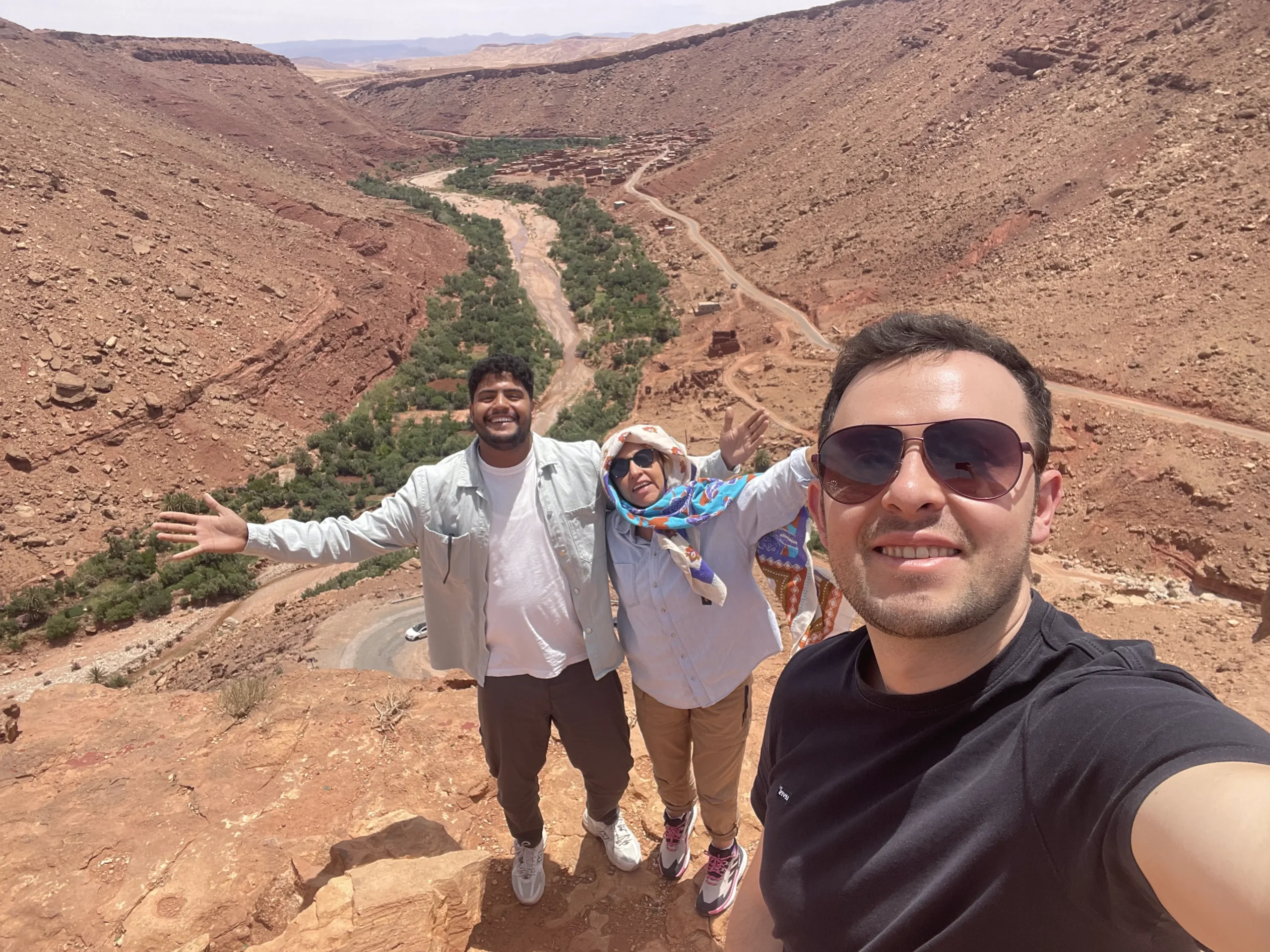
- Morocco 2 week itinerary
- FAQs
- 14 day Morocco tour
For a first visit, yes. A Morocco itinerary 14 days long covers the main regions: Marrakech, the High Atlas, the Sahara, the Middle Atlas, Fes, the Rif town of Chefchaouen, Rabat and the Atlantic coast. It does not cover everything, and no trip does. The trade-off is driving. Five days have between four and six and a half hours on the road, so tell us if you would prefer a gentler pace.
Spring (March to May) and autumn (September to November) are the most comfortable seasons for this route, with warm days and cool nights. Summer is very hot in Marrakech, the Dades Valley and Merzouga, so mornings and evenings matter more. Winter brings cold nights in the desert and in Midelt, and snow can slow the Tizi n’Tichka pass and the Middle Atlas roads. The Valley of Roses flowers around April and May. Ask us what to expect for your travel dates.
Limitless Morocco Tours plans personalized trips, so tell us what you would like to change. You might want an extra night in Fes or a shorter day on the road. Because every change affects driving time on other days, we will tell you what works before you decide.
The travel arrangements for this tour, including group size, transport and guiding, are confirmed directly with Limitless Morocco Tours. Send us your dates and the size of your group, and we will confirm the details with your quote.
Two nights, on Days 5 and 6, in the Merzouga desert area. The second night gives you a full day there without any driving. Ask Limitless Morocco Tours about the camp, including its facilities and what you can do there, before you book.
Pack for big temperature swings, and keep it light:
- Layers, including a warm jacket for evenings in the mountains and the desert, especially from autumn to spring
- Comfortable closed shoes with good grip for medina stones and ksar paths
- A hat, sunglasses and sunscreen
- Loose, modest clothing that covers shoulders and knees in the medinas, and a scarf for sun, wind and dust
- A headlamp or phone torch for the desert
- A power adapter for Type C and E sockets (220 V)
- Some cash in dirhams for markets, small cafés and tips
It suits couples well. For families, it depends on the children’s ages. The road days of four to six and a half hours, the winding mountain roads and a night in the desert can be tiring for young children. If you are traveling with children, tell us their ages and we will talk through whether this route fits.
This page shows the route and where you stay: Moroccan hotels or riads, plus two nights in the Merzouga desert area. The full list of what the price covers, such as meals, entrance tickets, transport and guiding, is confirmed when you ask for a quote. Please ask for it before you book, so there are no surprises.
The tour is a loop from Marrakech back to Marrakech, and the order of days was chosen so you do not backtrack. Finishing somewhere else, such as Fes or Casablanca, would mean rebuilding the route, and drive times would change. Send us your flight details and we will tell you what is realistic.
Contact Limitless Morocco Tours to request a quote. Include your travel dates, the number of travelers, your arrival and departure times and any changes you would like to the route. We will reply with availability, price and the next steps.
Have Any Question?
- +212607747056
- contact@limitlessmoroccotours.com
- 4-day Casablanca to Marrakech desert tour
- 5-day Morocco tour from Casablanca
- 7-day Sahara desert tour from Casablanca
- 8-day imperial cities tour from Casablanca
- 10-day Morocco tour from Casablanca
- 10-day Imperial cities Tours from Casablanca
- 12-day grand Morocco adventure tour
- 14-day Morocco tour from Casablanca
- 3 Days Tour Marrakech To Merzouga Desert
- 3 Day Marrakech to Fes Desert Tour via Merzouga & Erg Chebbi
- 4 Day Sahara Desert Tour from Marrakech
- 4 Day Marrakech to Fes Desert Tour with Camel Trek & Sahara Experience
- 5-day Marrakech to Fes desert tour
- 6 day Morocco desert tour from Marrakech
- 7-day imperial cities tour Marrakech