Morocco Itinerary 7 Days: A Realistic Marrakech-to-Sahara Route
limitlessmoroccotours.com
23 October 2026
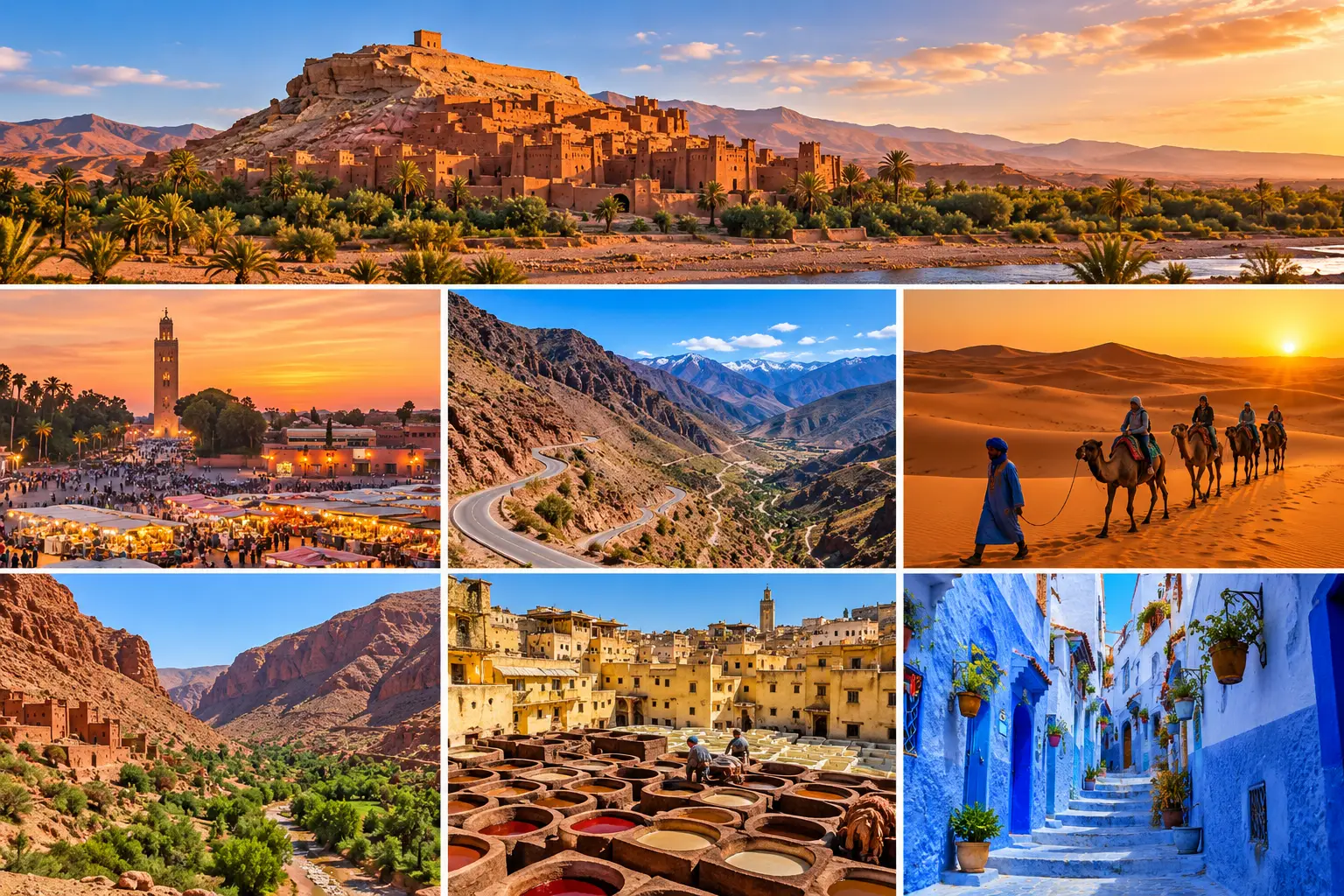
Seven days in Morocco is enough to explore Marrakech, cross the High Atlas Mountains, visit traditional villages, and spend time among the dunes of the Sahara Desert. But there is one important thing to understand before planning your trip: Morocco is a large country, and traveling between its most popular destinations takes time.
This Morocco itinerary for 7 days starts and ends in Marrakech. Along the way, you will visit Ait Ben Haddou, the Dades Valley, Todra Gorge, and Merzouga, where the golden dunes of Erg Chebbi begin.
The route includes two nights around Merzouga, giving you a chance to experience the desert without arriving one evening and leaving again the following morning.
It is a good option for first-time visitors who want to see the Sahara and do not mind several long driving days. If you prefer shorter journeys and more time exploring cities on foot, a different one-week itinerary may be a better choice.
Your 7-Day Morocco Itinerary at a Glance
Your 7-Day Morocco Itinerary at a Glance
Here is the proposed route, including where you will sleep each night.
Day | Route and highlights | Approximate driving time | Overnight |
1 | Arrive in Marrakech, explore the medina | Local transfers only | Marrakech |
2 | Marrakech → High Atlas → Ait Ben Haddou → Dades Valley | 6–8 hours | Dades Valley |
3 | Dades Valley → Todra Gorge → Merzouga | 4–6 hours | Merzouga |
4 | Explore Merzouga and the Erg Chebbi dunes | Short local transfers | Sahara desert camp |
5 | Merzouga → Rissani → N’Kob → Agdz | 5–6.5 hours | Agdz |
6 | Agdz → Ouarzazate → High Atlas → Marrakech | 5–7 hours | Marrakech |
7 | Marrakech sightseeing and departure | Local transfers only | — |
Driving times are approximate planning estimates, not live traffic estimates. They exclude meals, sightseeing, most photo stops, and unexpected delays. Road conditions and the precise accommodation locations can change the journey significantly.
For the best experience, arrange your flights so you arrive in Marrakech on Day 1 and depart on Day 7. If your return flight is early in the morning, you may have very little time for sightseeing on the final day.
Is 7 Days Enough to Visit Morocco?
Yes, seven days is enough to enjoy a rewarding trip to Morocco, provided you focus on one main route.
A week gives you time to experience several different landscapes and aspects of Moroccan culture. You can explore Marrakech’s markets, travel through Berber and Amazigh communities in the Atlas region, visit historic fortified villages, and spend a night in a desert camp.
What you cannot comfortably do is visit every famous destination in the country.
Trying to combine Marrakech, Fes, Chefchaouen, Casablanca, Essaouira, and the Sahara in seven days would leave very little time to enjoy them. You would spend much of your holiday transferring between places.
For a first trip, the best approach is to choose what matters most:
- For the Sahara Desert: Follow a route through the Atlas Mountains, Dades Valley, and Merzouga.
- For history and city life: Focus on Marrakech, Rabat, and Fes.
- For a slower holiday: Combine Marrakech with Essaouira and nearby excursions.
This itinerary prioritizes the Sahara because the journey offers a mix of mountain scenery, historic architecture, palm-filled valleys, and sand dunes.
Morocco 7 Day Itinerary: Day-by-Day Travel Guide
Day 1: Arrive in Marrakech and Explore the Medina
Start: Marrakech Airport or your arrival point
End: Marrakech
Overnight: A traditional riad or hotel in Marrakech
Driving: Airport or station transfer only
Your first day is about arriving, getting comfortable, and discovering Marrakech at your own pace.
If you arrive early, begin with a walk through the medina, the historic part of the city. Its narrow streets are filled with small shops, traditional workshops, restaurants, and markets known as souks.
Make your way toward Jemaa el-Fnaa, Marrakech’s main square. The atmosphere changes throughout the day, with food stalls and activity increasing toward the evening.
You can also see the exterior of the Koutoubia Mosque, one of the city’s best-known landmarks.
Do not try to visit every major attraction on your first afternoon. Between your flight, airport transfer, checking into your accommodation, and finding your way around, time can disappear quickly.
If you arrive late, have dinner near your accommodation and get some rest. The next day involves a long journey across the Atlas Mountains.
Practical tip: Consider staying in a riad near the edge of the medina if you want easier vehicle access. Some traditional accommodation is located along narrow pedestrian streets where cars cannot reach the entrance.
Day 2: Marrakech to Dades Valley via the High Atlas and Ait Ben Haddou
Start: Marrakech
End: Dades Valley
Overnight: Guesthouse or hotel in the Dades Valley
Estimated driving: 6–8 hours, excluding sightseeing and longer breaks
Leave Marrakech early in the morning and head toward the High Atlas Mountains.
The route crosses the Tizi n’Tichka mountain pass, where the road climbs through winding sections with views of hillsides, valleys, and small settlements.
Allow time for a short break and a few photographs, but remember that the drive itself is long. If you are prone to motion sickness, the mountain section is worth preparing for.
Your main sightseeing stop is Ait Ben Haddou, a traditional fortified village built mainly from earth and clay. It is a UNESCO World Heritage Site and one of the most recognizable examples of southern Moroccan architecture.
You can walk through the older part of the village, admire its towers and passageways, and climb to viewpoints if you are comfortable with uneven ground.
Allow roughly an hour or more for the visit, depending on your pace and whether you hire a local guide.
You will then continue toward Ouarzazate, Skoura, and the Dades Valley.
The scenery gradually changes from high mountains to rocky plains, oasis landscapes, and traditional villages.
By the time you arrive in the Dades Valley, you may have been traveling for much of the day. Check into your accommodation and enjoy a quiet evening.
What is worth prioritizing today?
Ait Ben Haddou deserves more time than several quick roadside photo stops. Unless you leave Marrakech very early and travel efficiently, adding film studio tours or large detours around Ouarzazate may make the day unnecessarily tiring.
Practical tip: In winter, daylight is limited. Aim to complete the mountain crossing and reach your accommodation before dark whenever possible.
Day 3: Dades Valley to Merzouga via Todra Gorge
Start: Dades Valley
End: Merzouga
Overnight: Desert-edge hotel or guesthouse near Erg Chebbi
Estimated driving: 4–6 hours, excluding sightseeing and longer breaks
After breakfast, continue toward Tinghir and Todra Gorge.
Todra Gorge is known for its steep rock walls and the narrow valley running between them. It is a worthwhile place to stop, stretch your legs, and enjoy a short walk.
You do not need to spend several hours here to appreciate the landscape. A relaxed stop of around 30–60 minutes can work well if the access conditions are suitable and you want to reach the desert before evening.
After leaving the gorge, continue toward Erfoud and then Merzouga.
As you approach Merzouga, the scenery changes again. Rocky desert landscapes give way to the large sand dunes of Erg Chebbi.
This is the Sahara experience many visitors picture when planning a trip to Morocco.
Rather than immediately rushing into an overnight camp, I recommend spending your first night at a guesthouse or hotel near the dunes.
This gives you time to settle in, take a short walk if conditions allow, and enjoy the changing light without worrying about reaching a camp before sunset.
Why not go straight to the camp?
It is possible to reach a desert camp on the first evening, but this depends on your arrival time and the camp’s transfer arrangements.
Splitting the desert stay between a guesthouse and a camp gives you more flexibility, especially if the journey from Dades takes longer than expected.
Practical tip: Confirm the exact location of your accommodation. Properties described as being in Merzouga can be spread across different parts of the village and surrounding dune area.
Day 4: Explore Merzouga and Spend a Night in the Sahara Desert
Start: Merzouga
End: Erg Chebbi desert camp
Overnight: Sahara desert camp
Driving: Short local transfers, depending on activities
Today is the most flexible day of the trip.
Instead of spending another day crossing Morocco by road, you can slow down and explore the area around Merzouga.
If you wake up early, you may be able to enjoy the dunes in the morning light. Desert temperatures can change considerably between early morning and midday, so plan outdoor activities around the season.
Depending on your interests, the day could include a visit to a nearby village such as Khamlia, known for its musical traditions, or a guided excursion through the surrounding desert landscapes.
If you visit a community or attend a musical performance, choose arrangements that respect local residents and performers.
You do not need to book every available activity. Leaving some free time to enjoy the desert is often more rewarding than rushing between several excursions.
Traveling to Your Desert Camp
Later in the afternoon, arrange your transfer to the camp.
Depending on the operator and the camp location, this may be by camel, 4×4 vehicle, or a combination of the two.
Camel rides are optional. If you prefer not to ride, ask whether a vehicle transfer is available.
Also confirm how long the journey will take. Not every camp is located deep among the dunes; some are closer to the edge of Erg Chebbi.
Once you arrive, settle into your tent and enjoy the desert surroundings. If the weather is clear, the evening can be a good opportunity to observe the night sky away from strong urban lighting.
Remember that camping conditions vary considerably between properties.
Before booking, ask about private or shared bathrooms, hot water, electricity, bedding, heating, and how luggage reaches the camp.
Practical tip: Even when the afternoon feels warm, desert nights can become cold, particularly in winter. Pack a warm layer and check the expected overnight temperature.
Day 5: Merzouga to Agdz via Rissani, Tazzarine, and N’Kob
Start: Merzouga
End: Agdz
Overnight: Guesthouse or traditional accommodation in Agdz
Estimated driving: 5–6.5 hours, excluding longer breaks
Leave the desert after breakfast and begin your return journey toward the Draa Valley region.
Instead of repeating the route through Todra Gorge and Dades, travel through Rissani, Alnif, Tazzarine, and N’Kob toward Agdz.
This route offers a different side of southern Morocco.
You will see rocky hills, broad dry landscapes, and settlements that feel quite different from Marrakech and the sand dunes.
Rissani is an important local town in the Tafilalt region. If your timing fits a market day and you have enough time, a short visit can be interesting. However, it is not worth delaying the entire journey just to include another stop.
Continue toward N’Kob, an area known for traditional earthen buildings and nearby mountain landscapes.
It can be a convenient place for a meal or a break, depending on your route and the options available that day.
By late afternoon or evening, aim to reach Agdz, a small town near the Draa Valley and its palm groves.
Agdz is a practical overnight stop before the return journey across the Atlas Mountains.
Why stay in Agdz instead of driving directly to Marrakech?
Traveling from Merzouga all the way back to Marrakech in one day would mean a very long journey. Breaking the return trip at Agdz makes the itinerary more manageable and allows you to experience another part of southern Morocco.
Practical tip: Carry water, snacks, and some cash. Food stops and services are more spread out on parts of this route than in major cities.
Day 6: Agdz to Marrakech via Ouarzazate and the High Atlas
Start: Agdz
End: Marrakech
Overnight: Riad or hotel in Marrakech
Estimated driving: 5–7 hours, excluding sightseeing and longer breaks
After breakfast, begin the return drive to Marrakech.
The route heads toward Ouarzazate before crossing the High Atlas Mountains again.
Although you are returning through part of the same mountain region, the changing direction and light provide different views of the landscape.
Stop for lunch or a coffee when convenient, but keep the day’s main goal in mind: getting back to Marrakech without making the journey unnecessarily long.
If you already spent time at Ait Ben Haddou on Day 2, there is no need to repeat that visit.
The Tizi n’Tichka crossing can take longer when roads are busy or weather conditions are poor. Snow or adverse weather in the mountains can sometimes disrupt travel during colder months.
Plan a sensible departure time and avoid booking a tightly scheduled evening activity in Marrakech.
After arriving, check into your accommodation and enjoy a relaxed dinner.
If you still have energy, return to Jemaa el-Fnaa or explore the streets near your riad.
Practical tip: Staying in Marrakech the night before your departure is much safer for flight planning than attempting the long return from the Sahara on the day of your international flight.
Day 7: Explore Marrakech and Prepare for Departure
Start: Marrakech
End: Marrakech Airport or onward destination
Driving: Local transfer only
Your final day depends on your departure time.
If you have an afternoon or evening flight, you may have enough time for one more activity.
You could explore a part of the medina you missed on arrival, visit a museum or garden, or shop for a few souvenirs.
If you are interested in Moroccan architecture, consider visiting a historic palace or traditional building, provided its opening hours fit your schedule.
Avoid planning several attractions on the same morning, especially if you need to collect luggage and travel to the airport.
For an early flight, treat this as a departure day rather than a sightseeing day.
Practical tip: Arrange your airport transfer in advance and allow enough time for traffic, airport procedures, and the airline’s recommended check-in period.
What Is the Best Way to Travel Around Morocco in 7 Days?
Transport makes a major difference to this itinerary.
The journey includes mountain roads, smaller towns, and desert destinations that are not directly connected by rail.
Here are the main options.
Private Tour with a Driver
A private vehicle with a driver can make the itinerary easier to organize.
You can arrange stops based on your interests, discuss suitable accommodation locations, and make adjustments when practical.
For example, if you want more time at Ait Ben Haddou, you may be able to reduce other stops rather than follow a fixed group schedule.
However, a private tour does not eliminate the distances. You will still spend several hours in the vehicle on multiple days.
Before booking, ask what is included in the quoted price, whether the route can be customized, and how the desert camp transfer is arranged.
Renting a Car
A rental car gives independent travelers control over their schedule.
It can work well if you are comfortable driving on winding mountain roads and planning fuel stops, parking, and accommodation.
Try to avoid unnecessary night driving, especially on unfamiliar roads.
Check the rental agreement carefully, including insurance coverage and restrictions on unpaved roads. A standard rental car may not be suitable for every camp access route, so you may need to arrange a separate desert transfer.
Trains and Public Buses
Morocco’s rail network is useful for traveling between several major cities, but there is no train directly into Merzouga.
Buses and local transport can help budget travelers reach parts of southern Morocco, but matching public transport schedules to every stop on this route is more complicated.
You may need additional taxis and longer connections.
If you want to travel mainly by train, a one-week city itinerary through Marrakech, Rabat, and Fes is a more practical alternative.
Where to Stay During Your One-Week Morocco Trip
Choosing accommodation in the right locations can save valuable travel time.
For this route, I recommend the following:
Night | Location | Accommodation type | What to check |
1 | Marrakech | Riad or city hotel | Access, airport transfer, arrival time |
2 | Dades Valley | Valley guesthouse or hotel | Exact location, parking, dinner |
3 | Merzouga | Desert-edge guesthouse or hotel | Distance from dunes, camp transfer arrangements |
4 | Erg Chebbi | Desert camp | Bathrooms, bedding, heating, transfer method |
5 | Agdz | Guesthouse or traditional hotel | Location, meals, parking |
6 | Marrakech | Riad or city hotel | Departure transfer, luggage arrangements |
In Marrakech, a traditional riad can be an interesting place to stay. Riads are houses built around an interior courtyard, and many now operate as guesthouses.
In the Dades Valley and Agdz, smaller guesthouses can provide a convenient base for an overnight stop.
For Merzouga, it is important to distinguish between accommodation at the edge of the dunes and a camp reached by an arranged desert transfer.
You do not need to choose the most expensive accommodation to enjoy the route. Location, cleanliness, reliable arrangements, and clear information about facilities are often more important.
Best Time for a 7-Day Morocco Itinerary
The route crosses several different climate zones, from Marrakech and the Atlas Mountains to the Sahara.
That means the weather may change significantly during the same trip.
Spring: March to May
Spring is often a comfortable period for this journey.
Daytime conditions can be suitable for sightseeing, while the landscapes around the Atlas Mountains and valleys may be particularly pleasant.
Conditions still vary, and wind or dust can occasionally affect desert activities.
Autumn: September to November
Autumn is another useful period for combining Marrakech, mountain drives, and the Sahara.
Temperatures often become more comfortable after the peak summer heat, although September can still be hot in southern Morocco.
October and November are worth considering if you want to avoid some of the strongest summer temperatures.
Summer: June to August
Summer can be extremely hot around Merzouga.
Long outdoor activities in the middle of the day may be uncomfortable or unsuitable. If you travel during summer, prioritize early mornings, evenings, reliable air-conditioned transport, and accommodation suited to the heat.
A city-and-coast itinerary may be more comfortable for travelers who dislike high temperatures.
Winter: December to February
Winter travel is possible, but prepare for very different conditions.
Days in some lower areas may be relatively mild, while desert nights can become very cold.
The High Atlas can experience snow and poor road conditions, which may affect the mountain crossing.
Shorter daylight hours also mean that long journeys require more careful planning.
Whatever the season, check the weather forecast and road conditions shortly before traveling rather than relying only on typical monthly conditions.
How Much Does a 7-Day Trip to Morocco Cost?
The total cost depends on your accommodation, transport, number of travelers, season, and activities.
A private trip for two people can have a very different per-person cost from a shared group trip or an independent journey using public transport.
For the itinerary above, your budget should include:
- Six nights of accommodation, including one desert camp night.
- Ground transport for the southern Morocco circuit, plus airport transfers where needed.
- Meals not included in your accommodation or tour.
- Desert activities and camp transfers, if charged separately.
- Entrance fees and optional local guides.
- Tips, personal spending, and travel insurance.
- International flights and any other expenses outside the Morocco tour package.
I have not included fixed accommodation or tour prices because current supplier rates, seasonal availability, and inclusions have not been independently checked.
For a useful comparison, request two or three itemized quotes based on exactly the same itinerary.
Ask whether the price is per person or per vehicle, whether the camp night is included, and whether fuel, driver expenses, meals, and entrance fees are covered.
The cheapest-looking quotation is not always the cheapest overall if essential services are excluded.
Practical Tips for Spending 7 Days in Morocco
- Keep Some Flexibility in Your Schedule
Traveling in Morocco can take longer than expected.
Mountain roads, traffic, weather, and sightseeing stops all affect arrival times.
Do not build a plan that depends on every drive finishing at the earliest estimated time.
- Pack for Several Different Climates
Bring comfortable walking shoes, sunglasses, sunscreen, and layers.
A light jacket or warmer clothing is useful for cool mornings and desert evenings. In winter, check whether you will need a proper warm coat for the camp.
Pack a small day bag for water, travel documents, medication, and essentials.
- Carry Some Moroccan Dirhams
Cards may be accepted at many hotels and larger businesses, but cash remains useful for smaller purchases, local meals, and tips.
ATMs and payment options can be limited in some smaller settlements.
- Respect Local Customs
Dress comfortably and respectfully, particularly in smaller communities.
Ask permission before photographing people, and respect a refusal.
During Ramadan, some restaurants, shops, and activities may operate differently. Check arrangements for the dates of your visit.
- Understand the Difference Between the Sahara and Agafay
Agafay, near Marrakech, offers a rocky desert-style landscape. It is not the same as the large sand dunes of Erg Chebbi near Merzouga.
If seeing high dunes is one of your priorities, confirm that your itinerary actually reaches a dune area.
- Avoid Packing Too Much into the Drive
Ait Ben Haddou, Todra Gorge, and Merzouga deserve time beyond a quick photograph.
If you add too many small stops, you may arrive at your accommodation late and tired.
Choose a few worthwhile experiences rather than trying to visit every attraction along the road.
- Check Essential Travel Requirements
Passport and visa rules depend on nationality, and requirements can change.
Before departure, consult your government’s current travel advice, confirm passport requirements, and arrange appropriate travel insurance.
Alternative 7-Day Morocco Itineraries
Not everyone needs to spend a week traveling to the Sahara. There are other ways to enjoy Morocco, depending on your interests.
Option 1: Marrakech and Essaouira for a More Relaxed Trip
Spend four nights in Marrakech and two in Essaouira.
You will have more time for the medina, traditional architecture, restaurants, and coastal scenery without several consecutive long road journeys.
This is a good option for travelers who want to combine city life with the Atlantic coast.
Option 2: Marrakech, Rabat, and Fes for Culture and History
Travel between Morocco’s historic cities instead of heading into the Sahara.
You can spend approximately three nights in Marrakech, one in Rabat, and two in Fes.
This route works best when your arrival and departure airports allow a one-way journey, or when you have accounted for the extra time needed to return to your original airport.
Trains are a useful option for much of this route, subject to current timetables.
Option 3: Marrakech with Shorter Day Trips
If you prefer to unpack once, spend most of your week in Marrakech and choose nearby excursions based on your interests and the season.
Possible options include the Atlas foothills, local valleys, or Essaouira.
You will see less of the country geographically, but you may enjoy a more flexible holiday with significantly less time in a vehicle.
Frequently Asked Questions About a 7 Day Morocco Itinerary
You can see several important destinations in one week, but not the entire country. Choose one main region or route rather than trying to combine every popular city and attraction.
Yes. Marrakech is a practical starting point for an itinerary through the High Atlas Mountains, Ait Ben Haddou, Dades Valley, and the Sahara. Starting and ending there can also simplify flight planning.
Yes. A week is enough to reach Merzouga from Marrakech and spend time around Erg Chebbi. However, the journey requires several long driving days, so it is not the best choice for travelers who prefer minimal road travel.
One night can give you a brief desert experience, but two nights in the area provide more flexibility. You can spend one night near the dunes and another in a camp without making every desert activity depend on a single arrival evening.
It is possible to plan a different seven-day route involving northern Moroccan destinations. However, adding both to the Marrakech–Merzouga loop described here would make the trip excessively rushed for most travelers.
No direct train reaches Merzouga. Visitors need road transport for the final part of the journey. If you plan to travel independently, check current bus services and local transfer arrangements before booking accommodation.
No. You can travel independently by rental car or use a combination of public transport and local transfers. A private driver may make the route easier to organize, especially if you want flexible stops and prefer not to drive in the mountains.
Yes, with sensible planning. Expect potentially cold desert nights, shorter daylight hours, and the possibility of snow or travel disruption in the High Atlas. Keep your itinerary flexible and check current road and weather information.
Final Thoughts: Is This the Right Morocco Itinerary for You?
This seven-day route offers a practical way to combine Marrakech, the High Atlas Mountains, traditional villages, and the Sahara Desert in one trip.
Its main advantage is the variety of experiences, with enough time around Merzouga to do more than arrive, sleep, and leave.
The compromise is the amount of driving. If you enjoy scenic journeys and want to see Erg Chebbi, the distances may be worthwhile. If you would rather spend several days exploring a city or relaxing by the coast, choose a slower itinerary.
If you would like help organizing transport, overnight stops, and a route suited to your travel dates, Limitless Morocco Tours can discuss a private, customized seven-day itinerary.
The best trip is not the one that covers the greatest distance. It is the one that gives you enough time to enjoy the places you have chosen.
- 4-day Casablanca to Marrakech desert tour
- 5-day Morocco tour from Casablanca
- 7-day Sahara desert tour from Casablanca
- 8-day imperial cities tour from Casablanca
- 10-day Morocco tour from Casablanca
- 10-day Imperial cities Tours from Casablanca
- 12-day grand Morocco adventure tour
- 14-day Morocco tour from Casablanca
- 3 Days Tour Marrakech To Merzouga Desert
- 3 Day Marrakech to Fes Desert Tour via Merzouga & Erg Chebbi
- 4 Day Sahara Desert Tour from Marrakech
- 4 Day Marrakech to Fes Desert Tour with Camel Trek & Sahara Experience
- 5-day Marrakech to Fes desert tour
- 6 day Morocco desert tour from Marrakech
- 7-day imperial cities tour Marrakech